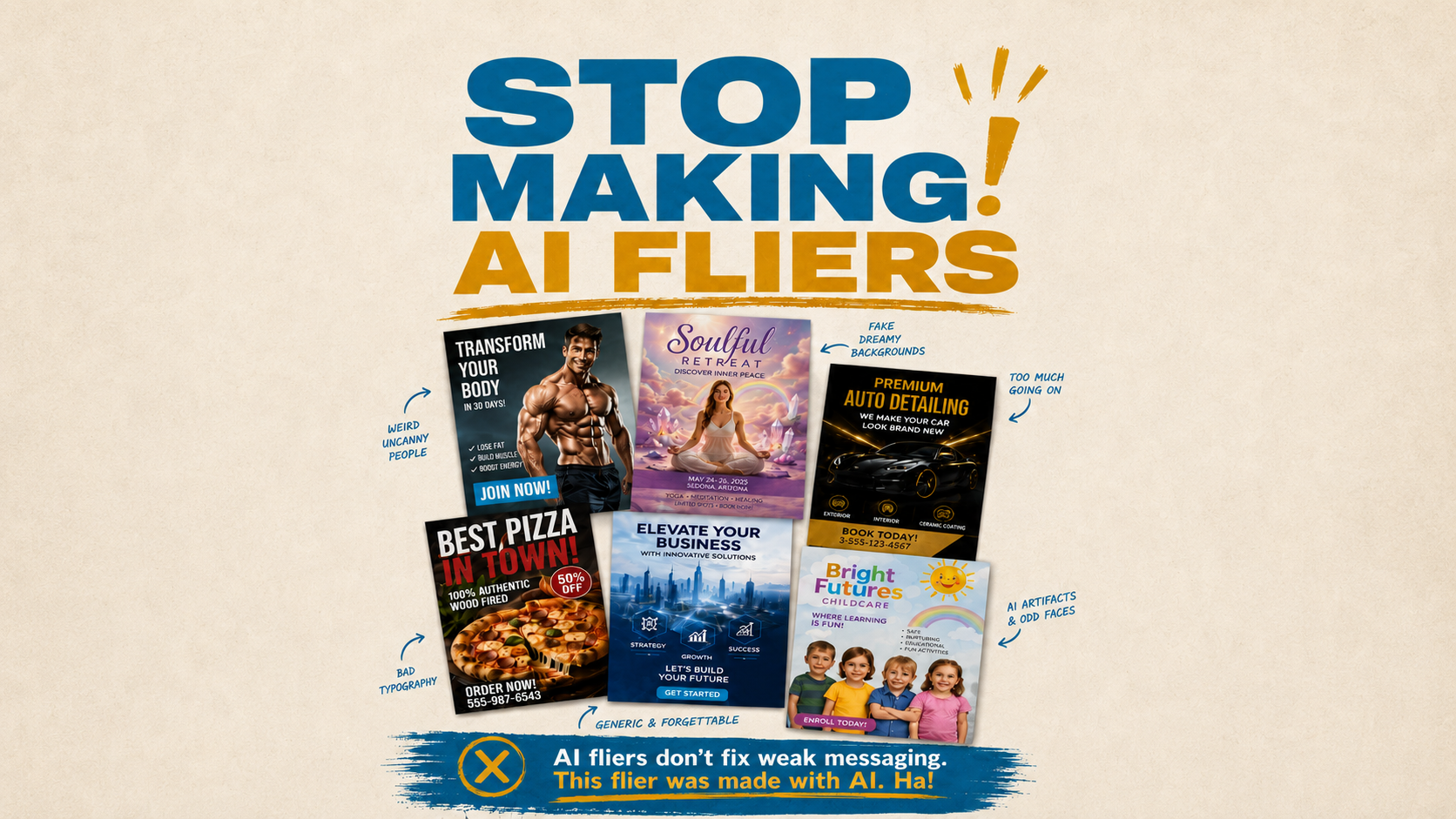
Most businesses do not have a content problem. They have a message problem. Another AI-generated flier will not fix that.
AI can be useful, but only when it supports your thinking instead of replacing it. If your marketing feels generic, the issue is not the tool. It is how the tool is being used.
Why AI Fliers All Feel the Same
AI tools are trained on patterns. When you ask for a quick flier, you usually get something that looks like everything else online. Clean design, basic headline, predictable wording.
That is not a technical failure. It is the expected outcome. Without clear direction, AI defaults to average. And average marketing is easy to ignore.
Your Customers Are Looking for Signals, Not Just Information
People do not choose a business based on a list of services alone. They look for signals that help them decide who to trust. Tone, clarity, and specificity matter more than volume.
A generic flier tells people what you do. A thoughtful message shows them how you think. That difference is often what earns attention and starts conversations.
Where AI Actually Helps
AI is a strong assistant when you give it a clear role. It works best in the early and middle stages of content, not as the final voice.
Brainstorming angles or campaign ideas
Organizing scattered notes into a draft
Rewriting content for clarity or length
Creating variations you can compare and refine
Used this way, AI speeds up your process without flattening your message.
What Still Has to Come From You
Your business has context that AI does not. You know your customers, your reputation, and the situations you handle every day.
That insight needs to shape your content. Adjust the wording. Add real examples. Remove anything that sounds like it could belong to any other business in your industry.
This is where personality shows up. Not in jokes or slogans, but in clear, honest communication that reflects how you actually operate.
A Simple Way to Use AI Without Losing Your Voice
Start with your own rough idea. Even a few sentences is enough. Then use AI to expand or organize it. After that, edit the draft as if it were written by someone who does not fully understand your business.
Ask yourself:
Would a customer recognize us in this?
Does this sound like how we actually talk?
Is anything too vague to be useful?
If the answer is no, keep refining. The final version should feel specific, not polished for its own sake.
Better Content Starts With Better Thinking
AI can help you move faster, but it cannot decide what matters. That part still belongs to you.
Businesses that stand out are not the ones posting more graphics. They are the ones communicating clearly and consistently. The tool can support that work, but it cannot replace it. That is true whether you are handling marketing in-house or working with a partner like Magic Mile Media.
Questions Business Owners Often Ask
Is it bad to use AI for marketing content?
No. AI is a useful tool when it supports your ideas. Problems usually come from relying on it to create finished content without review.
Why does my AI content feel generic?
Most AI outputs are based on common patterns. Without detailed input and editing, the result tends to sound like everyone else.
How much should I edit AI-generated content?
Enough that it clearly reflects your business. You should expect to adjust tone, add specifics, and remove anything that feels vague or interchangeable.
Can AI replace a marketing team?
No. It can assist with speed and organization, but strategy, judgment, and messaging still require human input.
What is a better alternative to posting more fliers?
Focus on clear, helpful communication. Answer real customer questions and explain how your business works in practical terms.